How to Organise a Tiny Entryway Without Drilling: 9 Fixes
In many small apartments the front door opens straight into the living room or kitchen. With no hallway, coats land on chairs, shoes gather by the door and keys vanish. A built-in coat rack would fix it, but that means drilling.
A working entryway needs four things: a place for coats and bags, a place for shoes, a small surface for keys and post, and a way to deal with wet weather. All four fit into about 3 ft (90 cm) of wall with nothing screwed in. These nine fixes are in the order that makes sense to do them, starting with the free ones.
Start with a quick plan
Stand at the open door and look at what you have. Measure three things and write them down:
- The width of free wall nearest the door on the handle side.
- How far the door swings in. Nothing can sit inside that arc.
- The walking width you must keep clear. Aim for at least 32–36 in (81–91 cm) so the route to the door is never blocked, including in an emergency.
Those numbers decide how deep your furniture can be. In most tiny entryways the answer is 10–12 in (25–30 cm).
The 9 fixes
1. Cut down what lives by the door
An entryway only needs what you use this week. One coat and one bag per person and two pairs of shoes each is a workable limit. Everything else goes to a wardrobe or under the bed. This costs nothing and makes every other fix smaller and cheaper.
2. Mark the zone with a mat or runner
A rug tells the eye "this is the entrance" even when there are no walls to do it. A 2 × 3 ft (60 × 90 cm) mat suits a single door, and a runner about 2 × 6 ft (60 × 180 cm) suits a corridor. Choose a low pile, under ½ in (1.2 cm), and check the door clears it. Put a non-slip underlay beneath it. A washable mat is worth having in a spot that takes all the outdoor dirt.
3. Use the back of the door
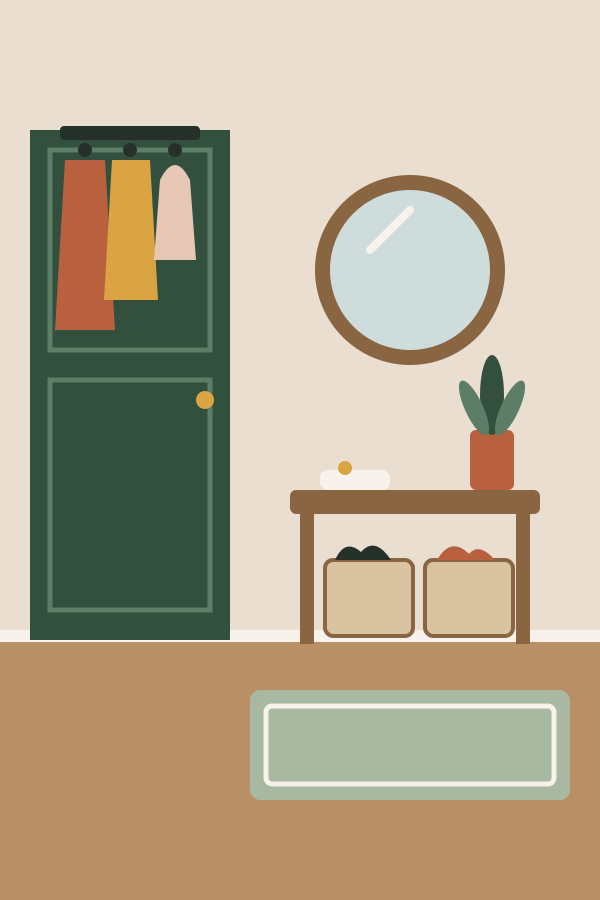
An over-door hook rail turns the front door or a nearby cupboard door into the coat rack. Rails with five or six hooks are typically rated 20–35 lb (9–16 kg) in total. A winter coat weighs 3–5 lb (1.4–2.3 kg) and a loaded backpack can reach 15 lb (7 kg), so count before you hang.
Check the gap at the top of the door first, and stick felt pads behind the rail to protect the paint. On a front door that is a fire door, or one with a closer fitted, do not hang anything that stops it shutting fully. Use an internal door instead.
4. Add a freestanding coat stand or rail
If the door will not take a rack, a coat stand needs a floor area of only about 18 × 18 in (45 × 45 cm). Look for a heavy or wide base, and hang coats evenly around it so it does not lean. A slim garment rail about 24 in (60 cm) wide with a shelf below holds more and doubles as shoe storage. Cost: $25–$70 (£20–£60).
5. Give shoes a boundary
Shoes spread until something stops them. Options, from slimmest up:
- A boot tray, about 15 × 30 in (38 × 76 cm), takes three or four pairs and catches water and grit. $10–$20 (£8–£16).
- A two-tier open rack, 10–12 in (25–30 cm) deep, takes six to eight pairs. $15–$35 (£12–£30).
- A bench with a shelf or baskets below adds somewhere to sit while you put shoes on. $40–$100 (£35–£85).
Slim tip-out shoe cabinets, only 6–9 in (15–23 cm) deep, are tempting for narrow halls. Most are designed to be fixed to the wall and will tip forward if they are not. Only choose one if the landlord agrees to the fixing.
6. Make a landing strip for keys and post
Keys get lost when they have no fixed home. Put a small tray or shallow bowl on whatever surface is closest to the door: the top of a shoe rack, a narrow console 10–12 in (25–30 cm) deep, or a floating-style shelf unit that stands on legs.
For keys on the wall, a small adhesive hook rated 1 lb (450 g) is more than enough, since a bunch of keys weighs a few ounces. Keep keys out of sight of windows and out of reach of the letterbox. Add one upright letter holder for post, and empty it weekly.
7. Add a mirror without hanging it
A mirror by the door is useful and makes a cramped entrance feel wider. Three no-drill options: a full-length mirror leaned on non-slip pads, an over-door mirror on its own hooks, or a light acrylic mirror under 3 lb (1.4 kg) on picture-hanging strips. Glass mirrors are heavier than they look, so weigh before trusting any adhesive. See how to hang pictures without nails for ratings.
8. Plan for wet days
Rain is what breaks an entryway system. A boot tray catches drips from shoes. A tall, narrow umbrella stand or simply a heavy ceramic pot holds wet umbrellas upright. Give wet coats a hook with air around them, not a crowded rail, so they dry properly and do not leave damp patches on the wall or door.
9. Light it
Entrances are often the darkest spot in an apartment. A rechargeable motion-sensor light bar, 8–12 in (20–30 cm) long, attaches with its own magnetic adhesive strip and switches on as you walk in. Most charge by USB and last two to six weeks between charges, depending on use. A small lamp on the console does the same job if there is a socket nearby. Cost: $12–$25 (£10–£20). There is more on this in lighting a rental without hardwiring.
Two layouts that work
For 24 in (60 cm) of wall: over-door hook rail, boot tray on the floor, key hook, leaning mirror beside the frame.
For 36–40 in (90–100 cm) of wall: bench with two baskets beneath, coat stand at one end, tray on the bench for keys, light acrylic mirror above on strips, runner in front.
Frequently asked questions
How do I create an entryway when there is no hallway?
Mark out a small zone beside the door with a mat, then add one piece for coats, one for shoes and a tray for keys. About 3 ft (90 cm) of wall is enough for a bench, hooks on the door and a mirror.
Where do I put shoes in a small apartment with no closet?
Keep two pairs per person by the door on a boot tray or a slim two-tier rack about 10 to 12 in (25 to 30 cm) deep. Store the rest under the bed or in the bottom of a wardrobe.
Can I hang a coat rack with adhesive strips?
Coats are too heavy and are pulled on too often for adhesive strips to be reliable. An over-door hook rail or a freestanding coat stand is the better no-drill option.
Are over-door hooks bad for doors?
They are fine when the load is within the rating and felt pads protect the paint. Problems come from overloading, which strains hinges on light hollow-core doors, or from hangers too thick for the gap above the door.
How deep should entryway furniture be in a narrow space?
Around 10 to 12 in (25 to 30 cm) is usually the limit, and you should keep at least 32 to 36 in (81 to 91 cm) of clear walking width to the door.
What is the cheapest way to organise an entryway?
An over-door hook rail, a boot tray and a small bowl for keys cover coats, shoes and keys for about $30 to $50 (25 to 40 pounds) in total.