8 Ways to Fill a Large Blank Wall Without Drilling
A large empty wall is common in rentals: behind the sofa, beside the bed, along a hallway. Small pictures dotted across it tend to make the wall look bigger and emptier. What works is either one large thing or a tight group that reads as one large thing.
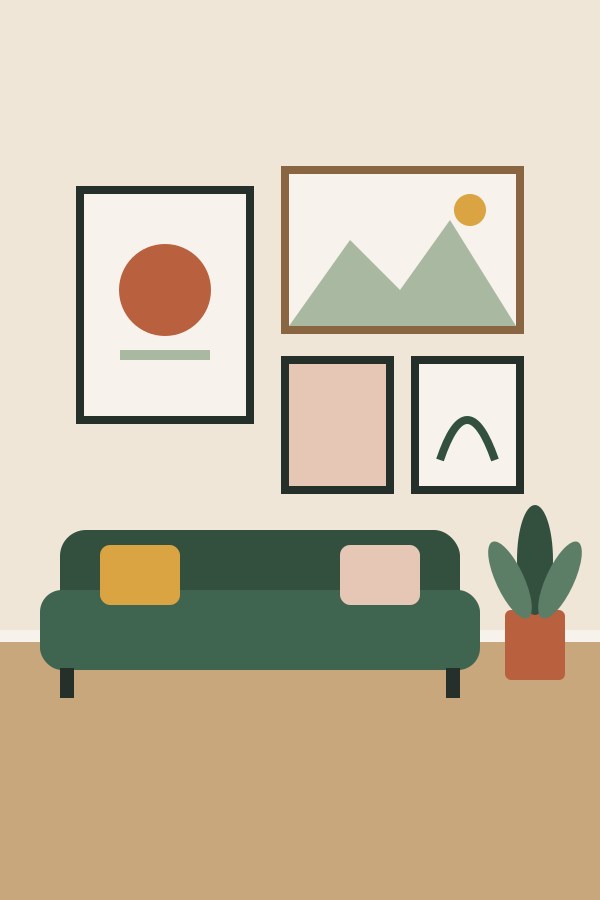
All eight ideas here avoid drilling. Some use removable adhesives, and several use nothing on the wall at all. Each includes the sizes that tend to look right, because scale is where most blank-wall attempts go wrong. A useful starting rule: whatever goes above a piece of furniture should span about two thirds of that furniture's width.
Two sizing rules worth knowing first
- The two-thirds rule. Above a 72 in (183 cm) sofa, aim for art or a grouping about 48 in (122 cm) wide. Much narrower looks lost.
- Eye level. The centre of a picture or grouping usually sits best around 57–60 in (145–152 cm) from the floor. Above a sofa, leave 6–10 in (15–25 cm) between the top of the sofa back and the bottom of the frame.
The 8 ideas
1. Lean a full-length mirror
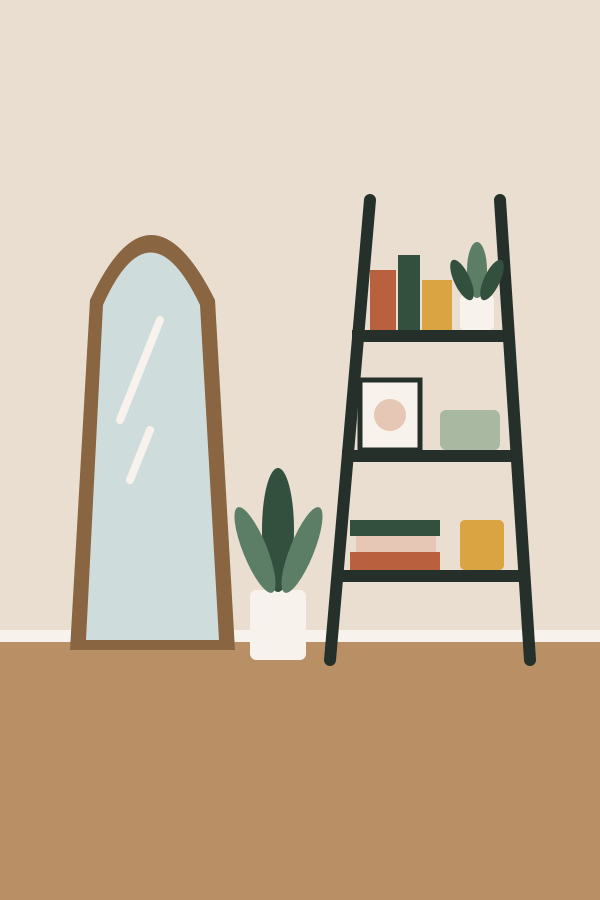
A tall mirror fills height, bounces light around and needs no fixing to hang. Look for something at least 60 in (150 cm) tall and 24 in (60 cm) wide. Arched tops soften a boxy room.
Leaning is not the same as unsecured. A mirror of that size can weigh 25–45 lb (11–20 kg). Stand its base 4–6 in (10–15 cm) from the wall on non-slip pads. If children or pets are in the home, add an anti-tip furniture strap, and ask the landlord about one small fixing if no adhesive version suits the weight. Rough cost: $60–$180 (£50–£150).
2. Build a lightweight gallery wall
A grid or cluster of frames reads as a single large piece. To keep every frame within the limits of adhesive strips, choose frames with acrylic glazing rather than glass and keep each one under about 3 lb (1.4 kg).
- Lay the frames on the floor and arrange them until the group is about two thirds the width of the furniture below.
- Keep gaps consistent: 2–3 in (5–8 cm) between frames.
- Trace each frame onto paper, cut the shapes out and tape them to the wall with low-tack tape to check the layout.
- Start with the centre frame at eye level and work outwards.
Six frames in two rows of three is the easiest layout to get straight. Our guide to hanging pictures without nails covers strip ratings and removal.
3. Hang one oversized, very light piece
Large does not have to mean heavy. A stretched canvas of 30 × 40 in (76 × 102 cm) often weighs only 3–5 lb (1.4–2.3 kg) because it is fabric over a thin wooden frame. A poster in magnetic wooden rails weighs less than 1 lb (450 g). Both hang from adhesive hooks or strips well inside their ratings.
Engineering prints and large-format poster prints of your own photos are an inexpensive source: about $10–$30 (£8–£25) for a print 24 × 36 in (60 × 90 cm).
4. Use fabric: a tapestry, quilt or rug
Textiles add colour and absorb echo, which helps in rooms with hard floors. A light cotton hanging of 50 × 60 in (127 × 152 cm) typically weighs under 2 lb (900 g).
The neat way to hang one is to slip a thin wooden dowel through a sewn pocket at the top, or clip the fabric to the dowel, and rest the dowel on two or three adhesive hooks. This spreads the weight and keeps the top edge straight. Heavier pieces such as wool rugs and quilts are better draped over a freestanding blanket ladder.
5. Put a freestanding shelf in front of it
If the wall is blank because there is nothing against it, furniture solves two problems. A leaning ladder shelf or an open bookcase 70–75 in (178–190 cm) tall fills the wall and adds storage. Style it with roughly one third books, one third objects and one third empty space so it does not look crammed.
Tall furniture should be secured against tipping. Many units come with a strap. If the lease rules out the screw it needs, choose a lower, deeper unit of 30–36 in (76–91 cm) and lean art on top of it.
6. Go tall with plants
One large plant covers a surprising amount of wall. A plant 5–6 ft (1.5–1.8 m) tall in a floor pot, or a trailing plant on a tall stand, breaks up a blank corner without touching the wall. For low-light rooms, good-quality artificial stems in a heavy vase do the same job with no watering.
Use a saucer or a pot without drainage holes inside a decorative one. Water marks on a rental floor are harder to explain than a nail hole.
7. Lean art on a long, low piece of furniture
A sideboard, a low bookcase or a bench against the wall gives you a surface to lean frames on. Use one large frame, around 24 × 36 in (60 × 90 cm), with one or two smaller ones overlapping in front. Add a table lamp at one end for height and the whole wall looks considered. Nothing is fixed, and you can rearrange it in a minute.
8. Try a removable decal or painted-effect shape
Large vinyl wall decals such as arches, circles and simple botanical shapes give the effect of a painted feature without paint. They carry the same surface caveats as removable wallpaper: smooth walls with eggshell or satin paint work, matte and textured walls often do not. A big arch decal behind a desk or a bed costs about $25–$60 (£20–£50). Test a small offcut for two weeks first. Our peel-and-stick wallpaper checks apply here too.
Which idea suits which wall
| Wall | Good options | Why |
|---|---|---|
| Behind a sofa | 2, 3, 4 | Furniture below gives a width to work to |
| Behind a bed | 3, 4, 8 | Light pieces only. Nothing glazed or heavy above a bed |
| Empty hallway | 1, 2 | Mirrors widen narrow spaces. Keep things flat to the wall |
| Bare corner | 5, 6 | Height matters more than width in a corner |
| Textured or matte wall | 1, 5, 6, 7 | None of these rely on adhesive |
Frequently asked questions
How do I decorate a large wall cheaply?
A large-format print of your own photo in magnetic poster rails, or a light fabric hanging on a dowel, covers the most wall for the least money. Either can be done for roughly $25 to $40 (20 to 35 pounds) including hooks.
How big should art be above a sofa?
About two thirds of the sofa's width. For a 72 in (183 cm) sofa that means a piece or grouping roughly 48 in (122 cm) wide, hung 6 to 10 in (15 to 25 cm) above the sofa back.
Can adhesive strips hold a gallery wall?
Yes, if each frame is within the rating on the pack and the wall is smooth and clean. Choosing frames with acrylic instead of glass keeps the weight down and reduces risk if one does fall.
Is it safe to lean a large mirror against the wall?
It is safe when the base sits on non-slip pads a few inches from the wall and the mirror cannot be knocked easily. In homes with children or pets it should also be restrained with an anti-tip strap.
What can I put on a textured wall where nothing sticks?
Use ideas that stand on the floor or on furniture: a leaning mirror, a ladder shelf, tall plants, or frames leaned on a sideboard. A picture rail, if the room has one, also works on any wall surface.
How high should pictures be hung?
The centre of the picture or group usually looks right at about 57 to 60 in (145 to 152 cm) from the floor, which is average eye level. Adjust a little lower in rooms where people are mostly seated.