9 Ways to Light a Rental Without Hardwiring
The standard rental lighting plan is one bright fitting in the middle of each ceiling. It lights the floor, flattens the room and leaves the corners dim. Changing the fitting means wiring, which is a job for the landlord's electrician, not for a tenant.
You do not need to touch the wiring to fix the lighting. Everything here either plugs into a socket, runs on a rechargeable battery or screws into an existing lamp holder. The aim is simple: three or more light sources per room, at different heights, with warm bulbs. Most people then stop using the ceiling light at all.
Two numbers that make bulb shopping easier
- Lumens are brightness. Around 450 lumens matches an old 40 W bulb, 800 lumens a 60 W and 1,100 lumens a 75 W. An LED giving 800 lumens uses only 8–10 W.
- Kelvin is colour. 2700 K is the warm, slightly yellow light of a traditional bulb and suits living rooms and bedrooms. 3000 K is a cleaner warm white for kitchens and bathrooms. 4000 K and above looks cool and bluish, which most people find harsh at home in the evening.
The 9 ideas
1. Change the bulbs first
The cheapest fix is replacing mismatched or cold bulbs with warm LEDs of the same colour temperature throughout a room. Choose 2700 K, and look for a colour rendering index (CRI) of 90 or higher on the box, which makes colours and skin tones look natural.
Check the base type before buying. In the US most lamps take an E26 screw base. In the UK it is usually a B22 bayonet or E27 screw, with small E14 screws in many table lamps. Never fit a bulb with a higher wattage than the maximum printed on the fitting or shade. With LEDs you will rarely get near it. Cost: $2–$6 (£2–£5) per bulb.
2. Replace the ceiling light with an arc floor lamp
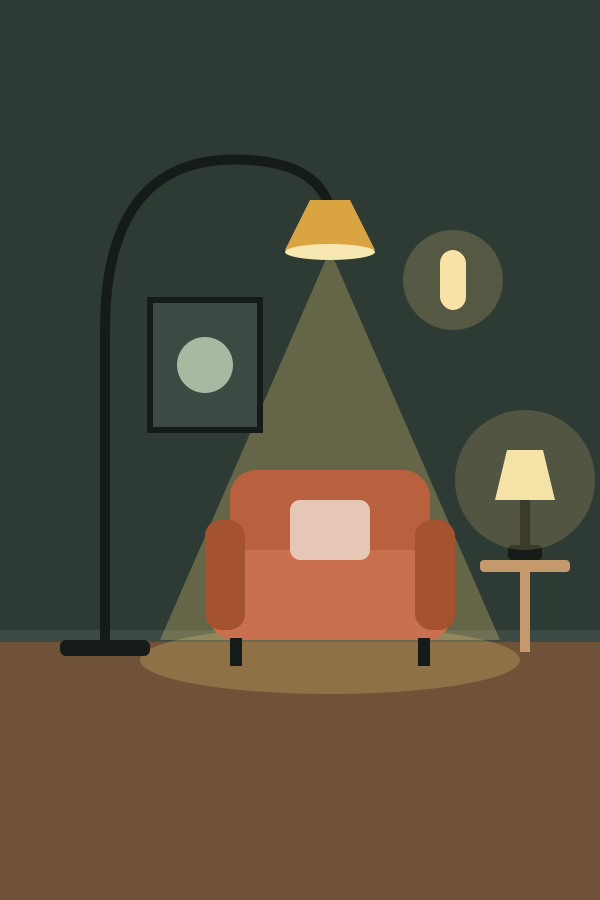
An arc lamp stands in a corner and reaches out over a sofa or table, putting light where a pendant would hang, but from a plug. Look for a heavy base, an arm reaching 40–60 in (100–150 cm) and a shade that sits at least 6 ft 6 in (2 m) above the floor wherever people walk beneath it. Cost: $60–$180 (£50–£150).
3. Layer table lamps at different heights
A small living room of about 150 sq ft (14 sq m) is comfortable with three or four lamps rather than one bright source. A workable set is a floor lamp in one corner, a table lamp beside the sofa and a small lamp on a shelf or sideboard. Spread them around the room in a rough triangle so no corner is left dark.
For a lamp beside a sofa or bed, the bottom of the shade should sit at about eye level when you are seated, so you do not look up into the bulb.
4. Use rechargeable wall lights
Battery-powered wall lights give the look of a fitted sconce with no cable. Many weigh under 1 lb (450 g) and can be mounted on picture-hanging strips rated for that weight, on a smooth painted wall. They charge by USB every one to four weeks, depending on brightness and use, and often include a remote or touch dimmer.
They are mood lights, not reading lights: expect 100–300 lumens. A pair either side of a bed or a mirror works well. Cost: $25–$60 (£20–£50) a pair.
5. Add light bars under cabinets and in cupboards
Kitchen worktops sit in your own shadow when the only light is behind you. Rechargeable LED bars 8–16 in (20–40 cm) long attach under wall cabinets with a magnetic strip and light the surface directly. Motion-sensor versions suit wardrobes, hallways and under-sink cupboards. Stick the magnetic strip to the underside of the cabinet, where any mark on removal will not show. Cost: $12–$30 (£10–£25).
6. Put LED strips on furniture, not walls
USB-powered LED strip behind a TV, under a bed frame or along the back of a shelf gives a soft indirect glow. The adhesive backing on strips is strong and is not designed to be removed, so it can pull paint. Stick it to your own furniture, or to a length of removable tape applied to the wall first. Choose warm white strips, and avoid placing them where the individual dots reflect in a screen or a window. Cost: $10–$25 (£8–£20).
7. Clip and clamp lights for beds and desks
A clamp lamp grips a headboard, shelf edge or desk up to about 2 in (5 cm) thick and takes up no surface space. It suits small bedrooms with no room for a bedside table. Pad the clamp jaws with felt if the surface marks easily. Cost: $15–$35 (£12–£30).
8. Change the shade, not the fitting
A dated ceiling light often looks better with a different shade. In the UK, most pendant shades are "easy fit" and attach with the plastic ring on the lamp holder, with no wiring involved. In the US, some flush fittings accept clip-on shade covers made for the purpose.
Switch the light off at the wall and let the bulb cool before touching it. Keep the original shade safe to put back, and make sure no fabric or paper sits close to the bulb. If changing the shade would mean opening the fitting or touching any wire, stop and leave it to the landlord.
9. Add control with smart plugs and bulbs
The drawback of lamps is walking round the room switching each one on. A smart plug, or a simple remote-control socket set, lets you turn several lamps on together from one button, a phone or a schedule. Smart bulbs add dimming and colour temperature changes in lamps with no dimmer.
Check the plug's maximum load and use it for lamps only, not heaters. Take them with you when you move. Cost: $8–$20 (£7–£18) per plug.
Cord and socket safety
More lamps means more cables. A few rules keep them safe and tidy:
- Do not run cables under rugs or through doorways, where they wear and overheat unnoticed.
- Plug extension leads into a wall socket, never into another extension lead.
- Add up the load on an extension lead and stay under its rating. LED lamps draw very little, but a heater or kettle on the same lead can exceed it.
- Use adhesive cable clips or a cord cover to route cables along skirting boards. Test the adhesive in a hidden spot first.
- Replace any lamp with a cracked plug, a frayed cable or a loose switch.
- In the UK, use plugs with the correct fuse. In the US, look for a recognised testing-laboratory mark on lamps and power strips.
Frequently asked questions
How can I add lighting to a rental without wiring?
Use plug-in floor and table lamps, rechargeable wall lights and light bars, clamp lamps and warmer LED bulbs in the existing fittings. None of these needs an electrician, and all of them move with you.
How many lamps does a small living room need?
Three or four light sources at different heights suit a room of around 150 sq ft (14 sq m). A total of roughly 1,500 to 3,000 lumens, spread across the lamps, gives a comfortable level for evenings.
Are rechargeable wall lights bright enough?
They are bright enough for atmosphere and for finding your way, typically 100 to 300 lumens each. For reading or cooking, add a plug-in lamp or an under-cabinet light bar.
Can I change a ceiling light fitting in a rental?
Not yourself. Replacing a fitting involves the fixed wiring, which should be done by a qualified electrician with the landlord's permission. Changing the bulb or an easy-fit shade is normally fine.
What colour temperature is best for a cosy room?
2700 K gives the warm light most people associate with a cosy room. Use the same colour temperature for every bulb in the room so the light looks consistent.
Is it safe to stick LED strip lights to the wall?
It is electrically safe if the product is certified and used as directed, but the adhesive can pull paint when removed. Fixing strips to furniture or to removable tape avoids the damage.
Do smart plugs work with any lamp?
They work with any lamp that has a physical switch you can leave in the on position. Lamps with touch controls or electronic dimmers often do not come back on when power is restored, so check before buying.