9 Rental Bathroom Upgrades With No Drilling and No Damage
Bathrooms are the hardest room to improve in a rental. The walls are tiled, so drilling risks cracking a tile and losing part of a deposit. The air is damp, so ordinary adhesives fail. And the room is usually the smallest in the home, with one shallow cabinet for everything.
These nine upgrades work with those limits. They use tension, gravity and adhesives made for wet rooms. Each one notes where it will and will not hold. Before buying anything, deal with damp: no product sticks to a wall with condensation running down it, and mould is a matter to report to the landlord.
First, ventilation and damp
Run the extractor fan during every shower and for 15–20 minutes afterwards, or open the window if there is no fan. Wipe down tiles and the shower screen with a squeegee, which takes a minute and removes most of the water that would otherwise evaporate into the room. If the fan does not work, or mould keeps returning after cleaning, tell the landlord in writing. Do not cover mould with stick-on products, and do not seal or block any vent.
The 9 upgrades
1. Replace the shower curtain and hang it higher
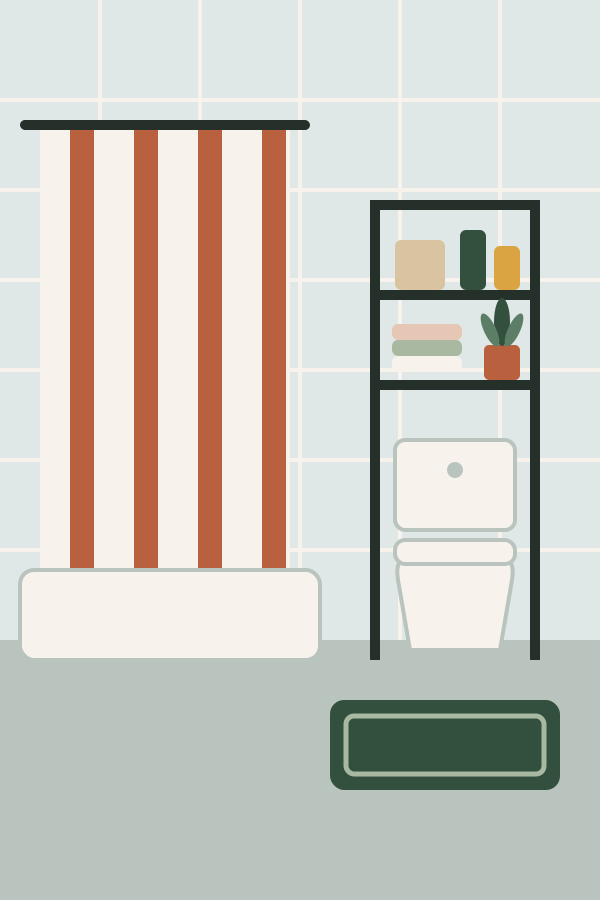
The shower curtain is the largest block of colour in most bathrooms, so a new one changes the room. Standard curtains are 72 × 72 in (183 × 183 cm). Extra-long ones, at 84 in (213 cm) or more, hung on a tension rod set closer to the ceiling, make a low room look taller.
Use a fabric outer curtain with a separate washable liner inside the bath. The bottom of the liner should hang 5–6 in (13–15 cm) below the bath rim. Wash both every month or so to keep mildew away. Leave the landlord's original rod in place, or store it. Cost: $20–$50 (£15–£40) for curtain, liner and rings.
2. Add a tension-pole shower caddy
A corner caddy on a spring-loaded pole stands between the bath rim, or shower tray, and the ceiling and carries three or four shelves. It holds far more than a caddy hung over the shower head and keeps bottles off the bath edge.
Measure floor to ceiling at the corner. Most poles adjust between about 5 and 9 ft (1.5–2.7 m). Choose rust-resistant stainless steel or coated aluminium. The top pad should press on a solid ceiling, not on a loose panel or directly on a light fitting or fan. Tighten until firm only. Cost: $25–$50 (£20–£45).
3. Use water-resistant adhesive hooks
Standard adhesive strips give up in steam. Bathroom-rated versions use a water-resistant adhesive and hold on glazed tile, glass, mirrors and fibreglass shower walls. Typical ratings run from 1 lb (450 g) for small hooks to about 5–7.5 lb (2.2–3.4 kg) for large ones.
- Stick to the flat face of a tile. Never bridge a grout line, where water gets behind the strip.
- Clean with rubbing alcohol, press for 30 seconds, and keep the hook dry for at least 12–24 hours before use. Follow the pack if it asks for longer.
- Do not use them on wallpaper, textured tile, natural stone or painted walls that get wet.
A dry bath towel weighs 1–1.5 lb (450–700 g) and more when wet, so one medium hook per towel is about right. Cost: $6–$15 (£5–£12) a pack.
4. Put a freestanding shelf unit over the toilet
The wall above the toilet is the biggest unused space in the room. A freestanding over-toilet unit has legs that straddle the cistern and two or three shelves above it.
Measure the width of the cistern and its height including the lid and flush button, then compare with the unit's inner dimensions. A common inner width is about 24–27 in (61–69 cm). Leave room to lift the cistern lid for repairs. These units are tall and narrow, so load the lowest shelf with the heaviest things and use the levelling feet. Cost: $35–$90 (£30–£80).
5. Add an over-door rail for towels
Bathroom doors are often the only place towels can dry flat. An over-door rail with two or three bars, or a row of hooks, needs only the gap above the door. Check the door thickness, add felt pads, and make sure the door still latches. Towels dry faster spread on a bar than bunched on a hook.
6. Organise under the sink and inside the cabinet
Under-sink cupboards are awkward because of the pipes. A two-tier organiser with a U-shaped cut-out or adjustable shelves fits around them. Inside a mirror cabinet, small clear bins stop things falling out. A lidded basket on the cistern top holds spare toilet rolls. A slim rolling cart, 6–8 in (15–20 cm) wide, fits between the toilet and the bath in many small bathrooms. Cost: $10–$35 (£8–£30).
7. Fit static-cling film for privacy
Frosted static-cling film gives privacy on a clear window without net curtains and without adhesive. Cut it about ⅛ in (2–3 mm) smaller than the glass, spray the glass with water and a drop of washing-up liquid, lay the film on and squeegee out the bubbles. It peels off in one piece. Avoid the self-adhesive type, which leaves residue and is harder to remove. Cost: $8–$20 (£6–£16) a roll.
8. Cover the floor without sticking anything down
Peel-and-stick floor tiles are widely suggested for rental bathrooms, but their adhesive can bond to the vinyl or lino beneath and damage it on removal. Water also gets under the edges. Loose alternatives are safer: a large washable bath rug, a cushioned vinyl mat cut to shape, or a slatted wooden duckboard beside the bath. Lift mats to dry after showers so moisture is not trapped beneath. Cost: $15–$60 (£12–£50).
9. Finish with textiles, a mirror and a plant
Matching towels in one or two colours, a soap dispenser to replace branded bottles, and a plant that likes humidity pull the room together. If the mirror is small, lean a larger one on a shelf where it cannot slip. Do not stick a frame onto the landlord's mirror with permanent adhesive.
For softer evening light, a rechargeable lamp rated for bathroom use can sit on a shelf well away from the bath, shower and basin. Keep anything mains-powered out of the bathroom unless it is designed for it, and never open or alter bathroom light fittings.
Worth asking the landlord about
Some popular upgrades involve plumbing or sealant, and are better agreed first:
- A new shower head. Many simply unscrew from the hose or arm by hand, and the original can be refitted later. It is still the landlord's plumbing, so ask, keep the original, and stop if anything is stiff or corroded.
- A new toilet seat. Two bolts hold it, and most landlords will not object. Keep the old one if they want it back.
- Fresh sealant around the bath. Failed or mouldy sealant lets water into the structure. Report it instead of patching it yourself.
Frequently asked questions
How can I add storage to a small bathroom without drilling?
Use a tension-pole caddy in the shower, a freestanding shelf unit over the toilet, an over-door rail for towels and a two-tier organiser under the sink. Together they roughly double the usable storage with nothing fixed to the tiles.
Do adhesive hooks work on bathroom tiles?
Water-resistant, bathroom-rated hooks hold well on smooth glazed tile when the surface is cleaned with rubbing alcohol and the hook is kept dry for 12 to 24 hours first. They fail on grout lines, textured tile and natural stone.
Do suction cups hold in a shower?
Only on very smooth, non-porous surfaces such as glass and glossy glazed tile, and only for light items. They tend to release with temperature changes, so do not rely on them for glass bottles or anything breakable.
Can I use peel-and-stick tiles on a rental bathroom floor?
It is risky. The adhesive can bond to the existing vinyl and damage it when removed, and water can get under the edges. A loose-laid mat or duckboard gives a similar result with no risk to the floor.
Can I change the shower head in a rental?
Often yes, since many unscrew by hand and can be swapped back, but it is part of the landlord's plumbing, so ask first and keep the original. Do not force a fitting that is stiff or corroded.
How do I stop mould in a rental bathroom?
Run the fan or open the window during and after showers, squeegee the tiles, wash the curtain liner monthly and keep the door open afterwards so air circulates. If mould keeps returning, report it to the landlord, because it may point to a ventilation or leak problem.