How to Make a Dark Rental Room Feel Brighter: 10 Fixes
Some rooms get very little daylight: north-facing bedrooms, ground-floor flats, rooms that look onto a wall or a lightwell. In a home you own, the usual answers are white paint and extra fittings. In a rental, both are normally off the table.
There is still a lot you can do. A dark room has two separate problems. The first is that not enough daylight gets in and travels across the room. The second is that the artificial light is too weak or in the wrong place. The first five fixes below deal with daylight and the next five with lamps and bulbs. Start with the free ones.
Get more out of the daylight you have
1. Clean the glass and clear the sill
Dirty windows block a noticeable share of daylight, and city grime builds up quickly. Wash the inside and, where it is safe to reach, the outside. Then clear the windowsill. Plants, photo frames and stacked books in front of the glass all cast shadows into the room. Keep the sill to one or two low items.
2. Hang curtains so they clear the window
Curtains that sit over the edges of the glass when open can cover 10–20% of the window. If a curtain pole is already fitted and extends beyond the frame, push the curtains fully onto the wall on each side. If the pole is only as wide as the window, tie the curtains back tightly during the day.
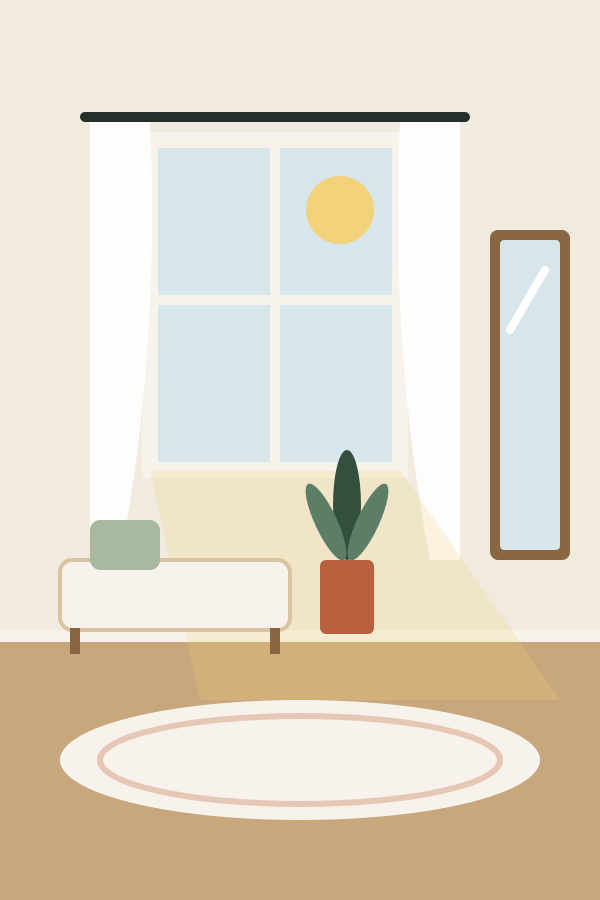
Swap heavy dark curtains for white or cream sheers on the existing pole, or on a tension rod inside the recess. Sheers give privacy and spread daylight more evenly across the room. If you need darkness to sleep, pair them with a separate blackout layer you can pull fully aside. Store the landlord's curtains clean and dry, and put them back when you leave.
3. Put a mirror beside the window, not opposite it
A mirror on the wall at right angles to the window catches light coming in and throws it deeper into the room. Opposite the window also works when the view is bright sky, but in many flats it simply reflects the building across the street.
Bigger is better. A mirror of at least 24 × 36 in (60 × 90 cm) makes a visible difference, and a full-length leaning mirror makes more. Lean it on non-slip pads, or hang a light one with strips rated for its weight. See hanging pictures without nails for limits.
4. Lighten the largest surfaces you own
You may not be able to paint the walls, but you control the rug, the bedding, the sofa throw and the curtains, and together those cover a large area. Dark floors absorb a lot of light. A pale rug of 5 × 8 ft (150 × 240 cm) over a dark carpet or brown laminate brightens the room more than any ornament. White or light bedding does the same in a bedroom, where the bed is the biggest object.
5. Keep tall furniture away from the window wall
A wardrobe or bookcase beside the window blocks light from spreading sideways. Put tall, solid pieces on the wall furthest from the window, or on the same wall as the door. Near the window, use low furniture and pieces on legs, which let light pass beneath and show more floor.
Fix the artificial light
6. Work out how many lumens you need
Most dark rooms are simply under-lit. A rough guide for living rooms and bedrooms is 10–20 lumens per square foot (about 100–200 per square metre). Kitchens and desks need more, around 30–40 per square foot (300–400 per square metre) on the work surface.
For a 12 × 12 ft (3.7 × 3.7 m) room, that is 1,400–2,900 lumens in total. One 800-lumen ceiling bulb falls well short. Add up the lumens printed on each bulb box and top up with lamps until you reach the range. A dark room should aim for the upper end.
7. Light the walls and the ceiling
A room feels bright when its walls and ceiling are lit, not when a pool of light falls on the floor. An uplighter floor lamp in a corner washes the ceiling, and the ceiling then acts as one large, soft light source. A table lamp with a pale shade near a wall lights the wall behind it.
Find the darkest corner at dusk and put a lamp there first. One lamp in the right corner does more than a brighter bulb in the centre. There are more plug-in options in lighting a rental without hardwiring.
8. Choose the right bulb colour for the time of day
For a gloomy room used in the daytime, such as a home office, bulbs around 3000–4000 K blend with daylight and feel fresher than very warm bulbs. For evenings, 2700 K is more relaxing. Smart bulbs that shift between the two cover both uses in one lamp.
Whatever the colour, look for a colour rendering index (CRI) of 90 or above. Low-CRI bulbs make a room look dull and grey even when it is technically bright enough.
9. Swap dark shades for pale ones
A black or dark fabric shade can block more than half of a bulb's light. White, cream or linen-coloured shades with a pale lining let far more through. A drum shade open at the top and bottom throws light up and down as well as outwards. This applies to easy-fit ceiling shades too. Keep the originals to refit later, and stay within the wattage limit marked on the shade.
10. Put lamps on a timer for dark mornings
In winter a dark room is at its worst first thing. A plug-in timer or smart plug that switches a lamp on 20 minutes before you get up, and again at dusk, means you never walk into a dark room. It costs $8–$20 (£7–£18) and uses almost no electricity with LED bulbs: a 9 W bulb running four hours a day uses about 13 kWh over a year.
What to skip
- Painting without permission. Repainting at move-out often costs more than the deposit deduction would have. If you want paler walls, ask. Some landlords agree if you use a neutral colour.
- Stick-on mirror tiles on walls. The permanent adhesive pads they come with take paint and plaster skim with them.
- Very cool "daylight" bulbs everywhere. At 6500 K a living room looks like a workshop at night.
Frequently asked questions
How do I brighten a room with no natural light?
Rely on several lamps rather than one ceiling light, aim for the upper end of 10 to 20 lumens per square foot, and point some of the light at the ceiling and walls. High-CRI bulbs and pale shades, rugs and bedding make the light you have go further.
Where should I put a mirror to reflect the most light?
On the wall at right angles to the window, as close to the window as practical, so it catches incoming daylight and sends it across the room. Opposite the window works too when the view outside is open sky.
What colour bulb is best for a dark room?
For daytime use, 3000 to 4000 K blends well with daylight. For evenings, 2700 K is more comfortable. In both cases choose bulbs with a colour rendering index of 90 or higher.
Can I paint my rental a lighter colour?
Only with the landlord's written permission. Some agree to a neutral colour, sometimes on condition that you repaint before leaving. Without permission, the cost of putting it right can come out of your deposit.
Do sheer curtains really make a room brighter?
Compared with heavy or dark curtains, yes. They let most daylight through, diffuse it across the room and can be left closed for privacy without making the room dark.
How many lumens does a bedroom need?
About 10 to 20 lumens per square foot. A 10 by 12 ft (3 by 3.7 m) bedroom therefore needs roughly 1,200 to 2,400 lumens in total, best split between a ceiling light and two or more lamps.